














Petting a snake, programming a game, studying blueprints and researching marketing techniques. These might sound like unusual activities for a typical classroom, but students can try all of them in the classes offered at White Station High School (WSHS).
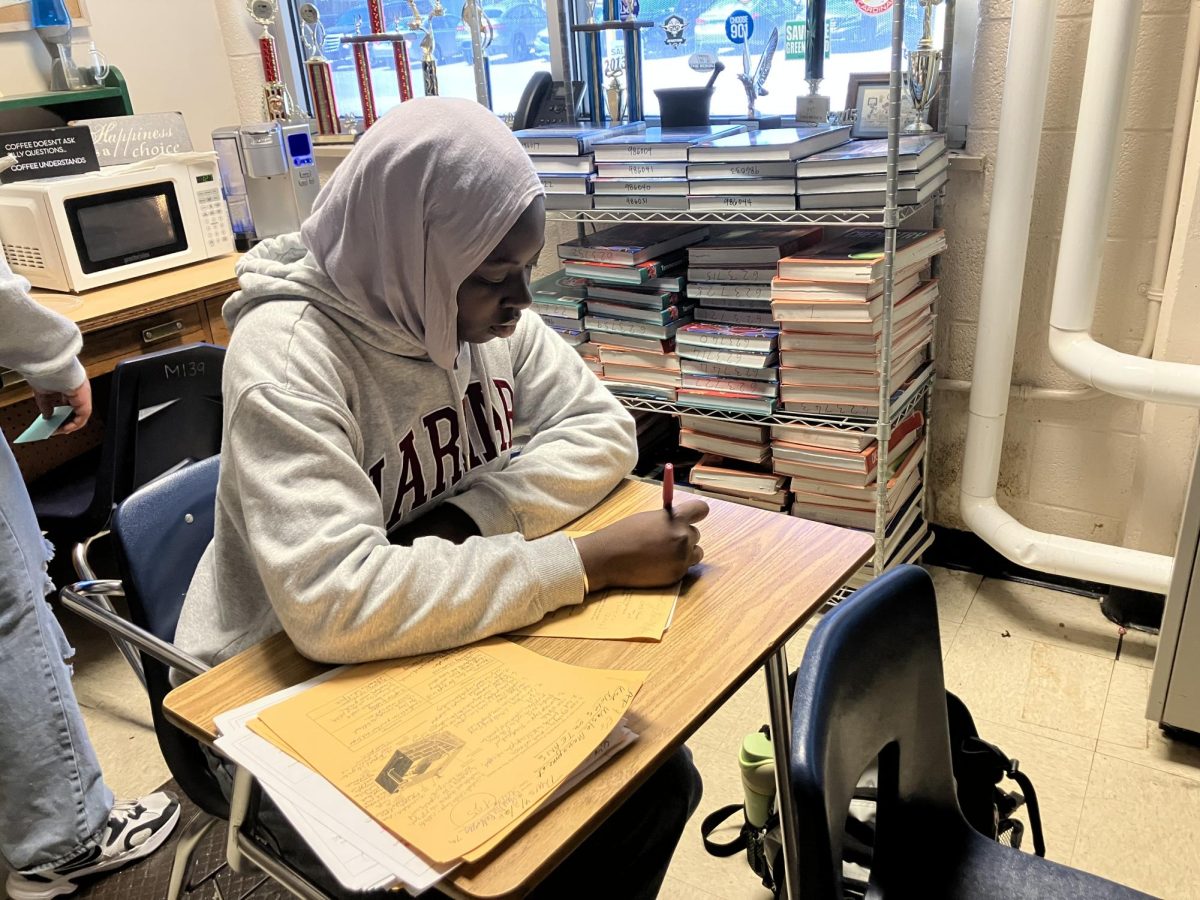
While many students know of WSHS’s various honors and Advanced Placement (AP) classes, students may be unfamiliar with the College, Career and Technical Education (CCTE) classes offered at WSHS. There are two categories of CCTE classes offered at WSHS: those taught on campus by WSHS teachers and the Vocational Technical Career and Tech (Votech) classes taught at Kingsbury High School (KHS).
Those offered at WSHS include Nursing Health Science, Marketing Management, Advanced STEM Applications, Information Technology, Teaching as a Profession and Office Management.
Those offered at KHS include: Barbering, Cosmetology, Maintenance and Light Repair, Culinary Arts, Health Science Education and Dual Credit (DC) Welding.
Nursing Education taught by Eno Madu
The Nursing Education path consists of four classes: Health Science Education, Anatomy & Physiology, Medical Therapeutics and Nursing Education, all taught by registered nurse Eno Madu. These classes teach students more about the human body and how it works, as well as offering the potential for students to be certified in CPR and become a certified medical assistant, certified nursing assistant or personal care technician. Students learn skills like taking manual blood pressure and are introduced to medical terminology that they can use later in life, regardless of whether they work in healthcare.
I feel like my students are better equipped when there’s a medical emergency to know exactly what to do and what not to do as they’ve called 911 and they’re waiting for help,” Madu said. “You know, if somebody in your family passes out, my students know what to do. Even when you don’t get into the healthcare field, I think it’s such a wonderful thing just to understand how your body works better. They learn over 200 medical terminologies. So when they do go to the hospital, when people are talking about them with medical terms, my students understand what is being spoken about. It just gives them a very well-rounded view of the medicine.”
Unlike her students, Madu was not so familiar with medical terminology before becoming a registered nurse. Though her high school offered CCTE classes, they were things like auto mechanics or woodshop, not the pre-professional technical career classes she now teaches. Formerly just a science teacher, Madu was called to nursing when it became related to her personal life.
“So, I was a teacher before I went to nursing school,” Madu said. “I taught middle school science for years, and because of [a] life issue, having a sick family member, I was interested in nursing because people in medicine had a tendency to talk over your head. And so I got tired of Googling everything doctors would say, so I decided to go back to school to become a nurse. And after working [as] a nurse for a couple of years, the opportunity came up [at] White Station to combine two things that I love, teaching and nursing, so I jumped at it.”
Marketing Management taught by Andrew Bell
Marketing Management consists of DC Intro to Business & Marketing, DC Marketing I: Principles I, Marketing II: Social Media & Analysis and Work-based Learning. Students of Bell’s class study marketing strategies used by companies, as well as general information about the economy that allows students to fulfill their Economic credit requirement.
“Some days we would do … a worksheet with marketing things, like matching vocabulary or, you know, looking at what we learned and how to put it in the real business and marketing world,” Sarah Scroggins (12) said. “So we learned a lot about the different global … economies in different countries, and also, like marketing strategies. So how businesses, you know, can use online marketing, how they use marketing in their stores, actually, and how even, like the setup of stores is all based on marketing.”
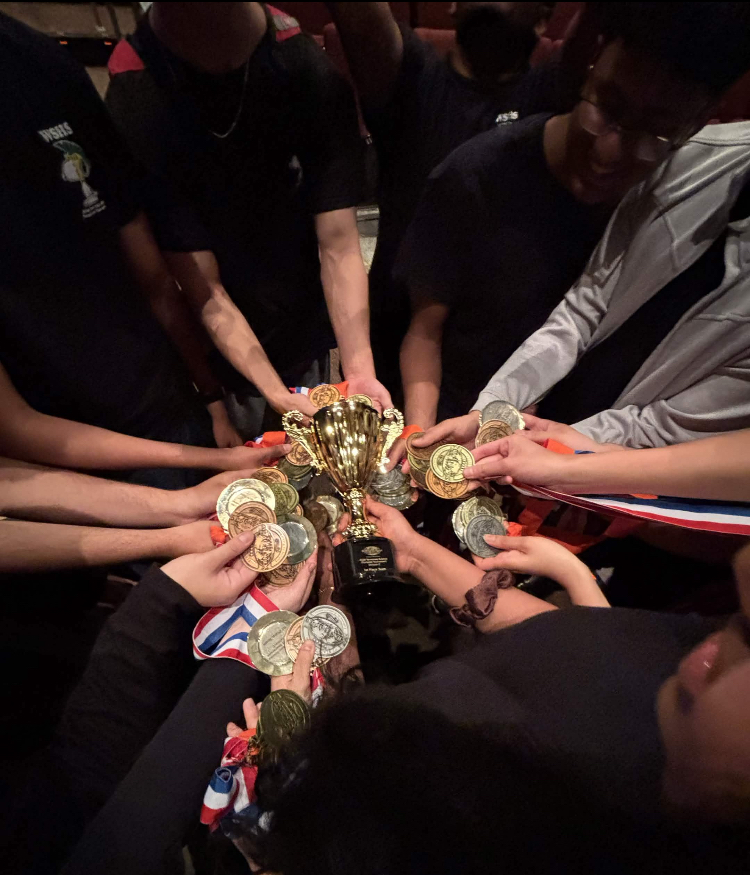
DECA, a competition centered around marketing and business, is only offered to Bell’s students. While not mandatory, marketing students are highly encouraged to join DECA as it offers them the chance to practice the skills they learn in class and travel for competitions to locations like Disney World. Students also have the opportunity for work-based learning, which allows them to leave campus early to work during school hours.
“So, in DECA … there is [a] 100-question multiple-choice exam … which is basically the material we review in class,” Scroggins said. “For districts and state, we go to a competition place, and you get a fake role play, which is like a business problem or marketing problem … And you just have like 10 minutes or 30 minutes … to prepare what you want to do for this business and how to fix the problem, and you present it to a judge and you’re dressed up in business attire and it helps you to talk professionally and … to present something on the spot.”
Information Technology taught by Jacob Walz
The Information Technology path starts with AP Computer Science Principles (CSP) and/or DC Computer Science Foundations, then moves to Coding I, Dual Enrollment (DE) Coding I and II, and then DE Coding III and IV and/or AP Computer Science A. The DE classes are taken through Southwest Community College. Students in these classes learn about coding concepts, such as programming language and syntax, and how to create their own coding projects, such as apps or games.
“For this year, we’re doing Java,” Leo Arazia (12) said. “And so we’re learning how the syntax and … how objects work in it, since it’s an object-oriented language. So once we do that, usually I take a day for reading, then a day for labs. So [for] labs, we put that knowledge [into] practice. In the textbooks, we learn about best practices. [For example,] when you’re writing code … variables, they have to be usually written in a certain way so that not only will it compile so that it will work in the program, it will also be readable and scalable. So then if you’re in a team and you need them to be able to work in the code, it’s good practice to be able to have [variables] be readable and efficient.”
Like with any course, Information Technology has its downsides. Consisting primarily of AP and DE classes, students may find Information Technology classes to be particularly difficult. There are further complications with DE classes as they don’t have an in-person teacher, only Jacob Walz, who acts as more of a proctor, which results in students needing to be independent in managing their coursework.
“You’re pretty much self-paced most of the time,” Arazia said. “And Java itself is very boilerplate, … which means it’s very complex. There’s a lot to it. So if you’re a beginner starting out or like you have trouble with syntax, it’s very hard to … to wrap your head around. I think it was much easier … with CSP, [because] Mr. Walz was actively teaching us. So it was definitely easier to understand the concepts we needed [to know] as well as apply them and pace ourselves well. Another downside is that you have to pace yourself. [If] you don’t pace yourself right, then you’re either gonna cram or you’re just not going to learn at all, which is a big hurdle you [have] to come over when programming.”
Office Management taught by Alicia Curry
Office Management consists of DC Computer Applications, Business Communications, DE Office Management I and II, and DE Office Management III and IV. Students learn skills that can prepare them for a professional career such as interviewing, resume writing and how to behave in an office setting. Students can also earn certifications in Microsoft programs like Word, PowerPoint and Excel.
“[I teach] software, just business etiquette, and I do thoroughly enjoy teaching students resume writing and interview skills and those things that can give them a tangible end. My students learn life skills. They learn soft skills, which are not really taught in the schools anymore. Each level of my students have the opportunity to get what’s called a Microsoft Office certification. They become MOS, Microsoft Office Specialists. And there’s another … communications certification that Southwest Airlines puts out. So when they leave my class, they will not only have learned these skills, they will actually be certified. And these are industry certifications that are recognized all over the country.”
While many students are placed into the class because there’s no room in other classes, they walk away with lifelong skills, and for some, a newfound interest in business. The soft skills learned from Office Management can be used in almost any career and help prepare students for the future.
“Believe it or not, many of [my students] are not [interested in business] when they come [to my class], because ever since my mom was teaching and probably before, CCTE … was known to be somewhat of a dumping ground for scheduling purposes,” Curry said. “With [Office Management] being an elective, oftentimes students are put in the class without a choice. However, I’m proud to say that many of the students develop a thirst for the knowledge and decide to go into business-related careers. Many of them find themselves here, and they’re like, ‘Oh, why am I here?’ But as [the] year goes on, they realize it’s beneficial.”
Advanced Science, Technology, Engineering and Math (STEM) Applications taught by Luis Herrera
The advanced STEM applications course is taught by Luis Herrera and starts with STEM I: Foundations, STEM II: Applications, STEM III: DC STEM in Context, STEM IV: Honors Practicum.
Computer Science Foundations focuses not on programming specifically, but on the skills behind programming such as design and planning coding projects. These skills can then be developed in Data Science with each level growing increasingly more intricate statistics and data analysis.
“We use [Computer Science Foundations] as a precursor for Data Science since we do have a lot of coding that we start doing in there, in both Excel and Python, the programming language,” Herrera said. “With [Data Science] I, we start off with … an introduction, we introduce a lot of stats concepts, things that students will have seen before such as mean, median and mode and range, just some smaller calculations, and introducing the coding behind specifically data science. In [Data Science] II, we jump into some higher level stats concepts, where … we make more intricate conclusions and interpretations and [gather] our own data … and [learn] really all the little intricacies of those processes. So we do scale up, not necessarily in difficulty, but in how specialized we become throughout the classes. With Data Science III, it’s more of a conversation of natural language processors or neural networks … things that build up into what are known as [Artificial Intelligence] or machine learning devices even, which is a lot of what data science includes, especially in industry jobs.”
Votech Career & Tech – Kingsbury Campus
Students who are interested in a CCTE class not offered at WSHS can travel to Kingsbury High School (KHS) to take Barbering, Cosmetology, Maintenance and light repair, Culinary arts, Health science education or DC Welding. Students in the Votech program at KHS would arrive at WSHS at 7:15 a.m. and then take a bus in either the morning or afternoon to spend two periods at Kingsbury. There, students would have classes in their chosen field, studying things like safety or the skills needed in their field.
“[DC Welding] usually it’s just, like, a lot of studying,” Markos McCargo (11) said. “Right now, we’re … going back over safety … but other than that, [we] would study types of welding processes. And we’re getting ready to go in the shop once we finish our safety [training]. [Last year] there was a lot of studying blueprints, welding symbols and different types of processes. And I got my [Occupational Safety and Health Administration] (OSHA) 10 [hour] and CPR certification during that.”
Aside from just learning practical trade skills, students in any CCTE class can also develop skills that apply to a variety of fields. Even those not interested in pursuing a career in nursing or STEM, for example, can benefit from taking the many CCTE classes available. From practicing public speaking in Marketing to learning about the body in Nursing Health Science or earning certifications for a future career, students can find there are several benefits to taking any CCTE class.
“With CCTE, what they do is they don’t just give you an introduction to them,” Herrera said. “You have certifications that you can [earn] for most, if not all of the CCTE classes. [For STEM specifically,] in a world that has made computers so accessible … I do think having even a base level of understanding how programming works or how computer science works is important. That can be mixed in with so many things that have nothing to do with data or data science specifically. And on top of that, even being able to present something is also a big deal. When it comes to job interviews, you’re marketing yourself, you’re presenting things about yourself as well, and that is a presentation, a different one than you would see mostly in a classroom, but it is a presentation. And learning those different things, learning how to know what to do, what not to do, or even what works for you, are really, really big deals in just about [any career].”