














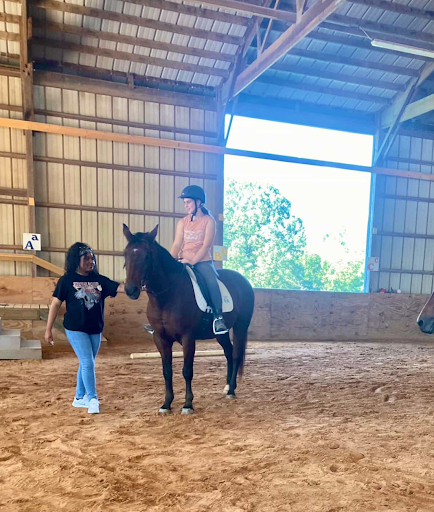
The Southern Reins Center for Equine Therapy is a nonprofit organization serving children and adults with disabilities through the therapeutic power of horses. These equine-assisted services are designed to help those struggling with hardships through planned physical, cognitive and emotional activities and therapies. This organization counts on high school students to assist their patients and the program. These students have learned to help patients one-on-one, and some have built long-lasting memories that they will carry with them in post-high school life.
“I was scrolling through the PDF [WSHS Key Club] sends every Friday, and I saw about the horses and I was interested,” Fiorella Villeana (12) said.
Volunteers start as “side-walkers.” In this role, volunteers stand by the horse and lightly hold the child to make sure they do not fall off their horse. The next level of responsibility is called a “horse-leader,” which is for more experienced volunteers. These volunteers take the rope and lead the horse while talking with their kids.
“The horse leader usually talks with the kids, so in the range, there are a bunch of toys and activities you can do,” Gabby Cain (12) said. “So you can take the toy and put it on this pole [or ask the kid] ‘What’s your favorite color? Green? Take the green circle and put it on the pole.’”
Students can reap many benefits from volunteering at Southern Reigns, especially for those interested in working with kids. For example, Cain, an aspiring healthcare worker, developed an interest in equine therapy. Cain fell in love with the mission of Southern Reins and has continued her volunteer work with the organization.
“I already knew I wanted to be in the healthcare field, and that includes therapy, and this is equine therapy,” Cain said. “I wanted to go because number one, I wanted to help the children, number two, I love horses, and this is just a great opportunity to help kids with disabilities.”
The experience of working with children and adults with disabilities has shifted the perspectives of many volunteers. By working one-on-one with children in particular, many volunteers have also have solidified their plans for their future endeavors.
“I hope that I made some type of impact on those kids’ lives,” Cain said. “It doesn’t have to be a huge impact. It can literally just be ‘I had a bad day and she made me feel better going to horse therapy.’”