
























A general paranoia exists within some people’s minds in the United States of being murdered. People become convinced that horrifying things are happening everywhere based on the media they consume, and they let that fear fester. Public perception of crime reflects fear that offenses like murder have been increasing over recently — but the opposite is true. According to the Department of Justice, the rate of murder went down 17.4% in 2024. Why, then, are people so convinced of an increase in crime?
Although there could be multiple reasons for this sometimes misplaced paranoia, most of it is tied to media literacy and a person’s ability to discern what is real, biased or entirely fake. A lack of examination on the source of news or any form of information can make a person susceptible to misinformation (incorrect or misleading information) or disinformation (deliberately false information usually published with malicious intent).
“I think media literacy is the ability to understand not only the content of the media, but who made it, what it was made for, and what its intended purpose is,” Lauren Larson, Advanced Placement English Language and Composition teacher, said. “Media is a huge category. [And there is a large difference in] when something is created for personal reasons, commercial reasons [or] political reasons.”
The intended purpose of a piece of media can reveal biases the author might hold. Through the omission of facts or spread of disinformation, media outlets like news broadcasters or social media influencers affirm the audience’s biases or views to gain more of a platform. Inversely, people often seek out information that supports their views, rather than information that challenges them in a subconscious act called confirmation bias. So even if a source of media isn’t extremely biased, a person can impose their own biases into the media they consume.
“[The media we consume] does affect decisions that we make, and those [decisions] do affect our lives, like how we vote, who we support and what we spend our time on,” Larson said. “You can be manipulated into thinking certain things that are not true or that are harmful if you’re not aware that everything that’s posted online has some kind of an agenda.”
Bias and confirmation bias can affect any side of a topic. Political news sources will compete for audiences. One well-known extreme would be Fox News, a right-leaning source of information, has been sued multiple times for spreading disinformation. When this occurs, they fall back on their First Amendment rights despite knowing the negative effects on their viewers’ perceptions of the world, as outlined by Yale University Joshua Kalla in “Consuming cross-cutting media causes learning and moderates attitudes: A field experiment with Fox News viewers.” It is not just Fox News, however. Most news outlets are owned by the same six organizations: AT&T, CBS, Comcast, Disney, News Corp and Viacom. These companies often decide what a viewer sees. In that way, the media that people consume is already biased. Bias can lead some people not to trust news sources and others to put all their faith into them.
“[Broadcast news networks] take false statistics and use anecdotal events to say, ‘Oh yes, of course, my viewer, you are so right to be scared of these people’ … when there is no reason to actually be fearful,” Cooper Shoe (11) said. “That’s basically all the news is, [it] is confirmation bias. It’s just allowing you a resource to say, ‘Oh yeah, I saw it [on] the news though. Fox told me that this is all completely true. And I’m not going to do any other research.’”
With the surge in use of artificial intelligence (AI), misinformation is now more easily spread. Instead of doing research and finding information from more credible sources, people now can use AI to generate responses to their questions. Oftentimes, though, AI pulls information from non-credible sources because it cannot differentiate between what is unreasonable or what is factual. Additionally, the user cannot always view where AI is acquiring the information it presents as fact and is unknowingly fed something false.
“I don’t think AI can [collect information and make art] better than us,” Shoe said. “But not just from a ‘I don’t like it’ point of view. It’s also harmful because if all of your information is from one [source], it’s, sure, it’s an amalgamation of a bunch of other people’s information, but it’s also [prone to] make stuff up. It’ll get information from sources that are not true.”
With the existence of social media, misleading photos and videos, doomscrolling teenagers will come across countless videos taken from broadcasting channels or created by AI, and if interacted with, will be fed more misleading content by the platform’s algorithm. This makes teenagers vulnerable to becoming trapped in echo chambers of information, where only one view is being shown to them or certain topics and not others.
“I think that teenagers [were born in] an important time when all media [already] existed all at once,” Larson said. “Millennials like me grew up when a lot of these technologies were coming out and were developing. And I think we have a better understanding of how they work because we can kind of see where they were built from. In general, I think we have a better idea how to determine what’s nonsense and what’s real, because we saw before it all kind of got covered up with AI and algorithms and such.”
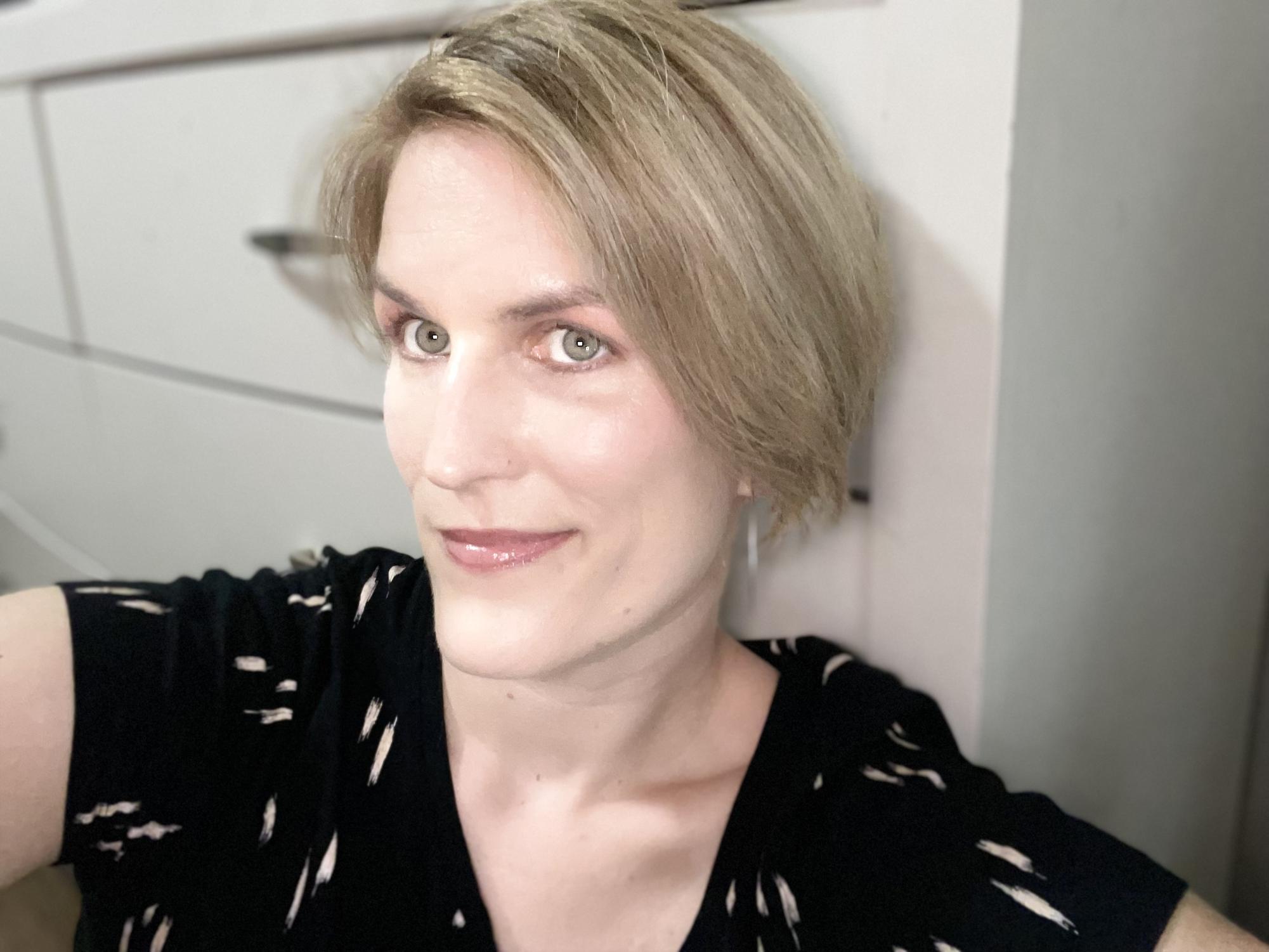
(LAUREN LARSON//USED WITH PERMISSION)
People aren’t helpless; there are multiple ways to combat the spread of fake news and misinformation. Looking at the sources of a piece of media or using unbiased online fact checkers, such as PoltiFact, Factcheck.org and Snopes, can be options to help determine the accuracy of a piece of media. Also, obtaining one’s news or information from various sources can help limit bias in the media one consumes. Additionally, if possible, reporting misinformation can stop it from spreading to more people who could believe it.
“So when I see something … that’s very dramatic, [I think to myself], ‘Maybe let’s check that out’,” Shoe said. “And sometimes it’s true. Recently it’s been very true. But there are other things that is, like, ‘Oh, that’s very dramatic,’ [and it ends up being false.]’”
People can take control of the media they consume and become conscious about the bias, purpose and source of a piece of media, leading them to possibly feel empowered. Their education on topics becomes more rounded with more media literacy and they are less likely to fall into echo chambers of information.
“If you’re able to break down who made this media — why did they make it [and] from what perspective are they speaking from — I think you’re less likely to be swayed by it one way or another and are able to maintain your sense of self,” Larson said. “But if all media is equal, then I feel like all messages equally play upon you, which I do think can eat at one’s sense of self.”