


























Students stare at the course selection forms being passed out by their counselors. They list the graduation requirements, and when they get to ‘two foreign language credits,’ both annoyed sighs and excited whispers can be heard across the room.
These differences in opinion over world languages credits extend from the student level all the way up to the state board. In November, Tennessee Board of Education chair Robert Eby submitted a proposal that suggested “reducing the required credits in World Language from two (2) to one (1) for students graduating after the 2025-26 school year; Increasing elective credits [from three to four] by adding a new ‘additional elective’ credit requirement.” After extensive pushback from students, educators, business leaders, teachers and parents, the bill was tabled, essentially temporarily set aside, in late February before ever being voted on.
“The Tennessee Board of Education is considering reducing the world language requirement from two credits to one for graduation,” Latin teacher Michael Garcia said. “And they are claiming this would give students more flexibility, and they’re also citing shortage of qualified world language teachers, and also referring to the changing workplace as reasons to consider the change, and moving world language under the banner of an elective focus category.”
Currently, students can request a waiver for the two language credits from their school district in order to focus on an area of elective study. However, these waivers are not standardized across the state and may be difficult to obtain or contain discouraging “negative” language according to Commissioner Lizzette Reynolds.
“If you take four years of high school, seven credits per year, there’s room for six more credits on top of the 22 required that you can still focus on,” Garcia said. “You can still focus on something other than language if that’s what you want to do, and also the waivers already exist. [Members of the TN Board of Education] are making a big deal about the waivers. Waivers exist. If you want to focus [on other electives], you can get a waiver to waive the world language requirement. It’s already there. We don’t need to drop the number of credits for world [languages].”
Moreover, reducing requirements may have other impacts. With the drop in enrollment in language two levels, schools may be unable to maintain their variety of less popular language offerings and may have to cut staff by as much as half, according to Spanish teacher Maria Magee.
“I know from personal experience, White Station High School used to require etymology,” Garcia said. “It was required for students in the optional program. They made it an optional course, enrollment dropped, and now they no longer offer etymology. That could happen to world languages, and it would especially affect languages like Latin, which are not offered by every school or considered a minority world language class.”
Some students feel that if they aren’t planning on focusing on languages, there is little point in taking two years of a language. After two years, Tennessee learning targets set a goal of Intermediate Low on the American Council on the Teaching of Foreign Languages (ACTFL) scale. Students at that level can “manage simple, predictable communication necessary for survival in the target language, such as personal information, basic needs, and common everyday contexts” but when interacting with native speakers they “may struggle to understand or be understood.” But, if a student stopped after the first year as the proposal would allow, the goal would be only Novice High, able to communicate “short messages” relying “heavily on memorized and learned phrases” with little concern for grammar. Even at Intermediate Low, programs like Google Translate usually outperform student abilities, and some students wonder if their learning will ever be applicable to daily life.
“Spanish is really useless,” Londyn Hawkins (10) said. “Personal finance, I feel like that’s a better class than Spanish because I’m actually taking the stuff that I know and applying it to my everyday life … I know I can’t speak Spanish; I know I’m not fluent in Spanish, and I don’t want to get fluent. I’m cool with my English conversations.”
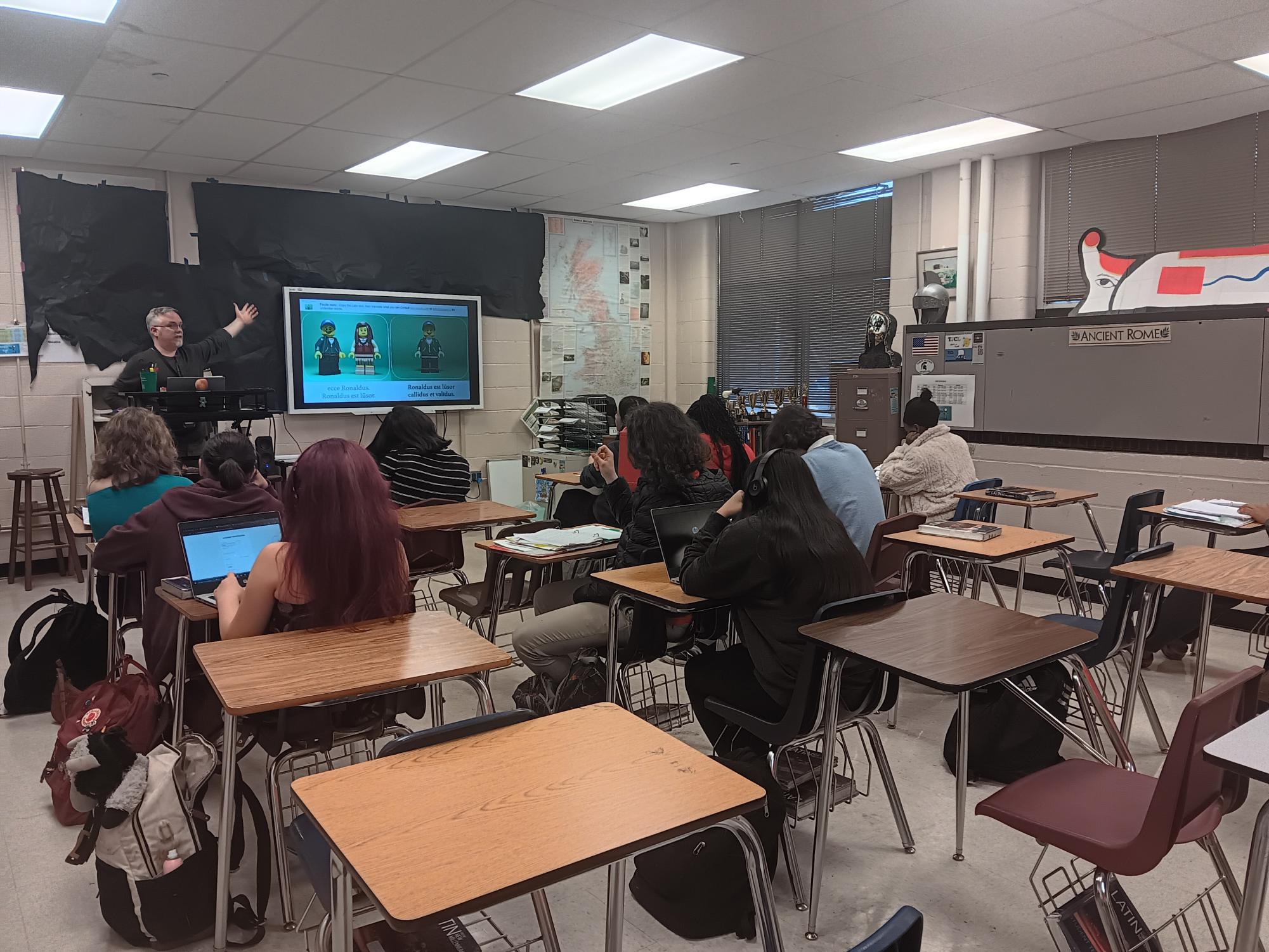
But fluency is not the only goal or benefit of language education for many. Many commonly taught languages evolved from similar roots as English. In some closely related languages (usually those that use the Latin alphabet), it is common to discover words that have similar meanings and sounds in both English and the language, called cognates. Those cognates can help learners discover new vocabulary or connections in their native language. And, if someone does get fluent in the foreign language, it can be a major selling point on job or college applications.
“When you speak another language, it makes you smarter,” Magee said. “You make better connections with your languages, English, Spanish. It helps you to understand your language better, and understand grammar better. You make those connections. Maybe you don’t get it in English, maybe you get it in Spanish. It’s great, because it’s problem solving. It’s good to prevent Alzheimer’s, it’s going to offer a lot of benefits in your job when you are older. Nurses make $6,000 more a year if they are bilingual … It opens opportunities to travel to many other places, or to find a job in one of those places.”
With recent government intervention in Latin America and immigration enforcement and attitudes toward immigrants, both Garcia and Spanish teacher Doug Insch feel that the language proposal speaks of a larger pattern. In recent elections, Tennessee has voted around 60% republican so the state Board of Education has a strong incentive to follow the trends of the national party.
“I find it worrying and concerning that they’re considering this, and to me personally, it suggests it might be part of the trend in this country towards fascism, which attempts to erase what is different and encourag[es] conformity,” Garcia said. “So it seems to me it smacks of a homogeneous culture where nonconformity or things that are different, things that aren’t part of the mainstream, are considered unworthy or inferior. And I think there might be some undertone of that going on here. It’s not explicit, but it fits in that trend of what’s going on in this country.”
The bill being tabled does not mean that the proposal is dead. The Tennessee World Language Teacher’s Association (TWLTA), which Magee is a member of and Garcia plans to join, recommends continued advocacy by students, parents, teachers and business leaders to inform the board of the community’s opinions. It suggests researching the importance of language education, then either speaking at state board meetings or writing to the board and convincing others, especially business leaders, to do the same. The west of Shelby county, election district nine, is represented on the Tennessee board of education by Darrell Cobbins, while the east including WSHS’s address, district eight, has Larry Jensen.
“If students are interested in voicing their opinions, I would recommend they go to the website for the Tennessee World Language Teaching Association, TWLTA.org,” Garcia said. “There’s a page dedicated to advocacy where they have a bunch of information. And you can, what you would need to do is contact your board representative … Write a letter saying you believe that the requirements, the credit requirements should not be dropped for languages. And [the] TWTLA website has a template you can modify to suit your voice to send to the board member to let them know how you feel.”