



















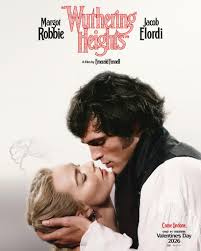
The 2026 “Wuthering Heights” adaptation was tragic — and not in the way Emerald Fennell intended. “Wuthering Heights” (2026) is the most recent of many “Wuthering Heights” adaptations from this past century. The “Wuthering Heights” movies are adapted from the classic Emily Brontë novel of the same name. Having not experienced “Wuthering Heights” before, I enjoyed the cinematography, concepts, acting and pacing. It came to me as a steamy romance period piece with peculiar characters. After discovering the commentary “Wuthering Heights” provides on classism and racism along with the book’s gothic and tragic nature, Fennell’s adaptation does not do Brontë’s “Wuthering Heights” justice.
The book is centered around the relationship between Catherine Earnshaw and Heathcliff. The story follows the characters from childhood. Earnshaw’s father adopts Heathcliff into the family, and they become inseparable. One night, Heathcliff overhears Earnshaw saying that marrying Heathcliff would “degrade” her. Hearing this drove away Heathcliff for three years, though he doesn’t know that in this same confession, Earnshaw reveals she irrevocably loves him. In that time, Earnshaw marries the wealthy Edgar Linton. When Heathcliff comes back, educated and wealthy, he plots for revenge. He marries Linton’s younger sister, Isabella, to spite Linton. After Earnshaw gives birth to her and Linton’s daughter, she experiences a severe decline in mental and physical health, stemming from the conflict between Heathcliff and Linton. The story ends with Earnshaw dying from her condition and Heathcliff being obsessed with her ghost.
Fennell’s recent adaptation takes many liberties that depart from the original story. For example, the character Hindley does not exist anymore and is instead fused into Earnshaw’s father’s character. In the book, Earnshaw and Heathcliff never kiss, while in the movie Earnshaw and Heathcliff have a physically intimate affair. Though there are many differences between the two, the biggest controversy in comparing the original to the adaptation is Heathcliff’s race changing. In the book he is described as dark-skinned. Heathcliff is abused in the household and degraded because of his dark skin, specifically by Hindley, which further fuels his thirst for vengeance. When Jacob Elordi, a white actor, was announced as Heathcliff, book lovers were in uproar. Major themes in the story are racism and classism, but these themes are not touched on at all in the movie.
Though this is disappointing, of the dozens of Wuthering Heights adaptations, Heathcliff is rarely portrayed as a dark-skinned man. I’m not saying it’s right that this is the case, but I don’t believe this version should be rejected for this reason if many other adaptations, which are deemed better, also neglect correctly portraying Heathcliff’s race.
One thing the movie did accurately depict was Earnshaw and Heathcliff’s obsession with each other. This obsession shows up in the film as a trauma bond. In the movie, when they were children, Heathcliff protected Earnshaw from being beaten by her father. Heathcliff professed with lashings in his back that he would always be there for Earnshaw and would experience the pain for her thousand-fold. Earnshaw then promises to never leave Heathcliff. From then on, we see a deep attachment they have with each other that’s platonic and childish. However, everything changes when they witness two servants engaging in intercourse. This incident serves as a catalyst for Earnshaw and Heathcliff admitting their physical attraction to each other. When Heathcliff comes back after his three-year disappearance to Earnshaw being married, their love is gamified as they both try to spite and make each other jealous. Despite this, after Earnshaw’s dad dies, they admit their longing for each other and proceed to engage in a love affair behind Linton’s back.
The affair is passionate, but it is less of a star-crossed romance and more of a mutually-unhealthy obsession gone wrong. Fans of the book are calling it fan-fiction, and questioning if Fennell even read the book. The thing is, it was never Fennell’s intention to accurately recreate “Wuthering Heights.”
“You can’t adapt a book as dense and complicated and difficult as this book,” Fennell said in an interview with Fandango. “I can’t say I’m making ‘Wuthering Heights.’ It’s not possible. What I can say is I’m making a version of it. There’s a version that I remembered reading that isn’t quite real. And there’s a version where I wanted stuff to happen that never happened. And so [this film] is ‘Wuthering Heights’ and it isn’t.”
It is easy to write this movie off when you are watching it with the expectation it will be an exact adaptation. It’s not. Despite its inaccuracies, the film is still enjoyable.
For one, the cinematography and visuals are excellent. Fennell uses bold colors and interesting set designs that aren’t historically accurate, but add whimsy and an element of fantasy to the movie. The film’s portrayal of the skin room is a perfect example of this. In the book, Earnshaw has a skin room, also known as a closet bed. These small spaces meant for sleeping were popular in the middle ages. Fennell adapted the skin room in the film to be literal photo copies of Margot Robbie’s, the actress of Earnshaw, skin on the walls. Linton presents Catherine the room he customized to represent her beautiful skin. You can see moles, hair, and veins on the wall panels. Another interesting visual was the portrayal of Earnshaw’s death. There are huge leeches on her person, as well as the walls of the skin room — a visual representation of her having her life and beauty sucked out of her. When Earnshaw dies, the movie’s colors are dark and muted. The movie loses its color and fantastical elements, which is symbolic of reality settling for Heathcliff as he lies beside her on her death bed.
Elordi and Robbie’s portrayals of Heathcliff and Earnshaw, respectively, were also highlights of the movie. Earnshaw is vain and self-obsessed, while Heathcliff is spiteful and brooding but yearns for Earnshaw. At first I found these characters annoying and lacking depth, but I realized the characters were perfectly portrayed for a story about an infatuation gone wrong. Earnshaw’s vanity is what drives Heathcliff away and Heathcliff’s spitefulness eventually kills Earnshaw. Their personality traits manifest into behaviors destructive of their relationship. Robbie and Elordi do a great job depicting this.
The movie was entertaining from start to finish. The pacing was engaging. If you watch the movie through the lens of the book, you’ll be sorely disappointed. But if you are down for a story about two people who are nonsensically obsessed with each other, this is the perfect movie for you.