



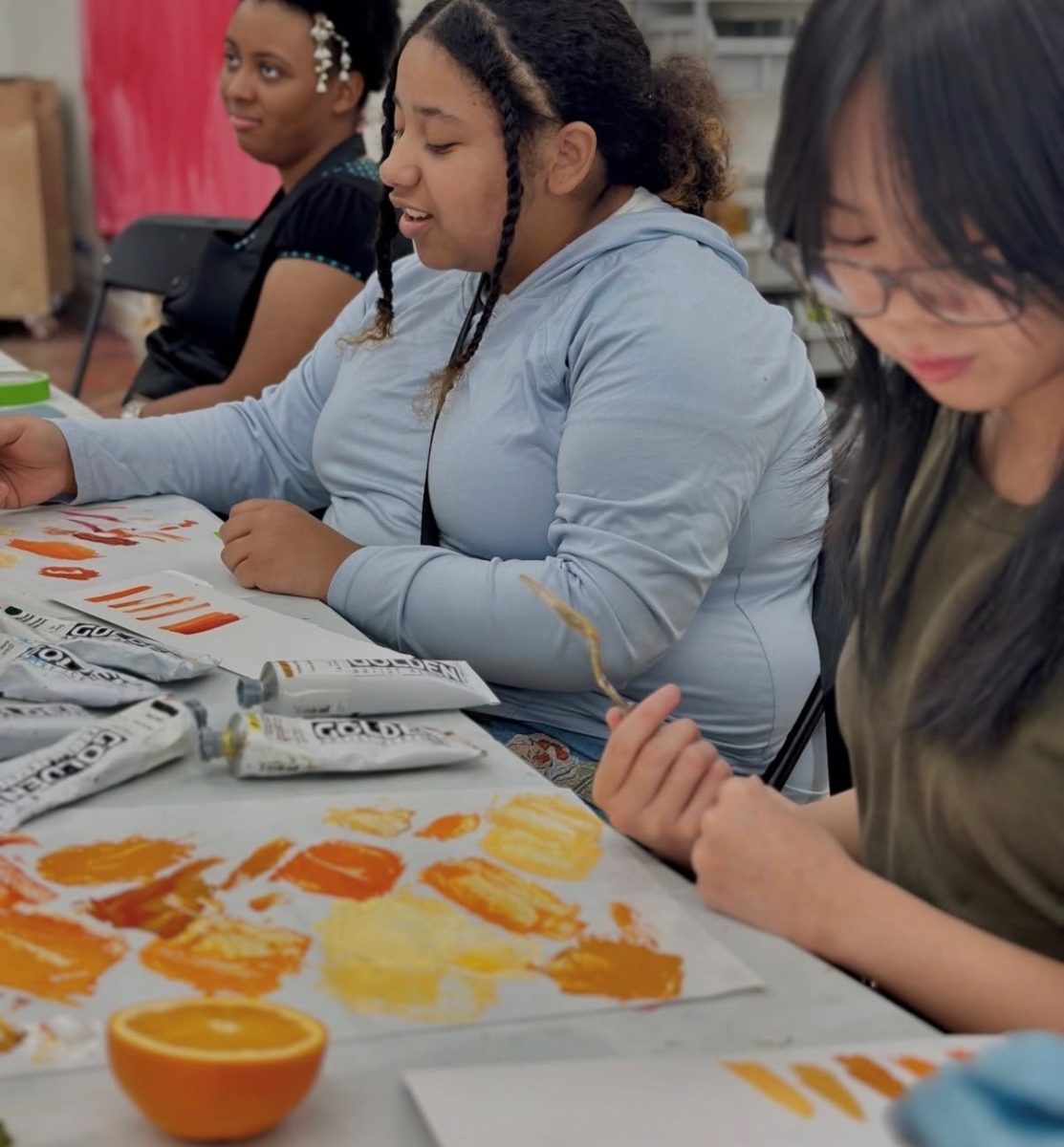
















Countless colors of paint swirl, blend and layer together; a synchronized beauty slowly unfolds as long hours of sweat and concentration come together into one award-winning finished piece.
The Scholastic Art Awards is an annual contest where teens from around the nation compete for prizes in categories ranging from architecture to comics. Each year, the Memphis Brooks Museum hosts the Mid-South region of the competition, where over 2,000 submissions are judged by a panel of art professionals and given awards. Honorable Mention and Silver Key winning pieces are displayed on a TV at the museum, while Gold Keys are displayed physically and submitted into the national level of the competition. Olivia Pullen (10) has been participating in art competitions since middle school.
“The Scholastic Art Awards is a high level contest,” Pullen said. “It’s a contest where many artists have the chance to win certain scholarships or high prizes. And the judging is really strict. So it’s a good opportunity to put your art in and have it known.”
When judging a piece, jurors consider three criteria: Originality, Technical Skill, and Emergence of a Personal Style or Vision. So, the focus is not only on the execution of a piece, but also on the message behind it.
“The contest values personal voice in addition to the technical ability of the student,” Andrew Dycus, an Advanced Placement (AP) and Honors art teacher at White Station High School (WSHS), said. “So, they’re looking for creativity and they’re looking for really strong technique — something that makes the student stand out as an individual within the artwork.”
The Scholastic Art Awards is unique among competitions for young artists. Other contests leading up to it, like the Mid-South and Delta fairs, only allow two submissions per school per grade level. So, there are fewer entries, less competition and not every student has a chance to participate. Scoring in AP classes, another big judged event for high schoolers, considers writing and improvement along with the art itself.
“In the AP judging … they focus more on the neatness and the quality,” Pullen said. “And it cannot be just … a sketch or anything. It has to be detailed … It’s more skill based. And with the Scholastic Art Awards, they focus more on the idea and what it conveys — the story behind it, almost.”

As with most years, WSHS students placed highly in the 2026 competition. Over 100 pieces submitted by almost 40 student artists received an Honorable Mention, a Silver Key or a Gold Key. WSHS seniors also won awards for their senior portfolios, which are collections of six pieces centered around a theme. In addition to winning eight Gold Keys, Long Do (12) won multiple awards given only to given only to one piece in each category, which is the highest honor in the entire competition.
“I didn’t expect to win as much as I did,” Do said. “And I was definitely surprised when I won the special awards, like the best in show … I won a Senior Best-In-Show, Senior Portfolio Award, and a Senior Painting Award … I think a Senior Portfolio Award is the best overall portfolio in the region. And Senior Best-In-Show is just best overall in the senior division, and the Painting Award is best painting.”
The recognition and benefits from the Scholastic Art Awards can go well beyond high school. While the competition does give out a few scholarships and cash prizes to the highest national winners, the biggest boon comes as a selling point for students on other applications. As an established national competition, the Awards give credibility to a student’s art achievements; admissions across the country know the standard implied by a Gold Key, regardless of location.
“I think winning these awards definitely helped me in the future by boosting my college applications for one,” Do said. “I think [the awards] maybe just show my artistic ability as an artist in the future; I can be recognized for that. And it’s just really a boost hitting any future endeavors I want to do with art, like in architecture.”
Whether or not a piece receives an award, the process of participating in the competition helps encourage students to create work they are confident to submit. The evaluation by outside jurors allows students to find places to improve that they may have missed before.
“I’m proud of whether the students ended up getting awards or didn’t get awards,” Dycus said. “I’m proud of the students who did really work hard and grow and put themselves out there. And I’m happy for the ones that did get recognition, because a lot of those students are so very talented and hardworking that they deserve all of the recognition that they got. But just once again, even though the students might not have gotten the recognition, it doesn’t mean that it wasn’t a worthwhile piece or wasn’t a good piece.”