











Painted rolling hills, cottony clouds and glazed rivers decorate the molded figure. This landscape’s creator can only hope that it survives in the over 2000 degree firebrick cylinder and comes out as a gorgeous piece of tableware.
Advanced Placement (AP) 3D Art and Design focuses on students exploring the fundamentals of design while creating various three-dimensional pieces and learning a variety of techniques in the process. Mostly 12th grade students take the class, but 10th and 11th graders are allowed to, as well.
“I think most people take [AP 3D Art] because a lot of people in there have taken an AP art before,” Addie Scoggins (12) said. “I’ve never taken AP Art, but a lot of people, I think, take it because it’s different than most of the other AP Arts that are like drawing or 2D [Art and Design] or things like that. This is just so different from any other class that we have.”
The most common medium in AP 3D Art at White Station High School is clay. Students have access to various types of clay, glazes and hand tools as well as a pottery wheel and a kiln.
“You have to be careful because if your thing dries out, it’s too late,” Scoggins said. “You can’t go back and make it to where you can add to it again … [But] clay is great [too] because, for example, when I’m working on the wheel, if I mess up and I’m making a bowl and then I accidentally make the side uneven, I can just start over.”
Some students opt for less conventional choices than clay. Shelby Thompson (12), for example, uses a slew of materials: felt, popsicle sticks, toothpicks, cardboard, faux moss, pipe cleaners and wood skewers. The College Board has no restrictions on what materials can be used, only forbidding the use of generative Artificial Intelligence at any stage in the process.
“A lot of different materials come together to be the model that, you know, that you see, like paper, also,” Thompson said. “I could make everything out of clay, just I like that I have the leeway and the ability to decide, and because, like, clay doesn’t work that well for everything I want to do. So it’s nice that I can use my skill and show off different things by, like, picking the best materials for the project or whatnot.”
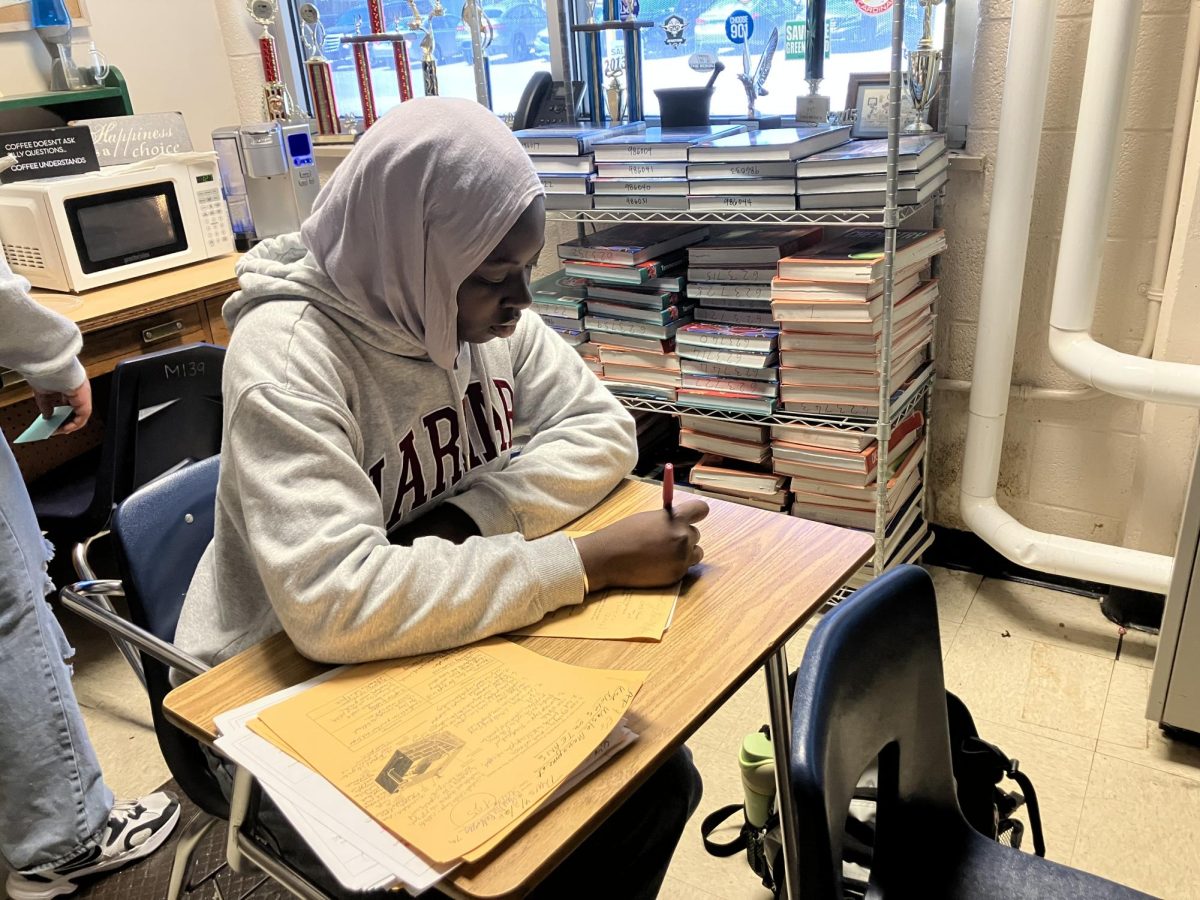
AP 3D Art does not have a rigid class schedule as students work on different parts of their portfolio at different times. But, since it is still a class, teacher David Pentecost is still required to enter grades. So, according to Scoggins, he sets “checkpoints” for the students to have at least one new piece completed by each new deadline.
“So there’s some days where Mr. Pentecost will kind of have a lesson, but it’s not a traditional lesson,” Scoggins said. “Like today, he pulled out a big bottle of wax and was like, ‘If you want to paint on your piece but don’t want the glaze to stick, you can paint this wax, and then it’ll burn off in the kiln’ … He teaches us different processes and tools that we can use to improve our work and to improve our skills in general, because a lot of us have never made anything like this before.”
At the end of the year-long course, students submit a two-part portfolio of their work. The first section is Sustained Investigation, which requires students to take and submit 15 photos of their pieces. Students also must explain why they chose their topic and how they applied their topic to their works. In the second section, Selected Works, students submit images of five of their pieces, showing two different perspectives of each for a total of 10 images.
“I’m definitely nervous because when we just send off pictures and it’s not Mr. Pentecost who has watched me make these things, [the AP graders] just see the final product,” Scoggins said. “So I am kind of worried because they can’t see the level that I started at. And so to me, I feel like, ‘Wow, I’ve gotten so much better and I’m really proud of myself for getting to here because I started here,’ but they don’t see that.”
Most students who take AP 3D Art do not plan to continue with art in college or as a career, but the skills they learn are useful outside of art. Thompson, for example, intends to pursue architecture, and finds that the class is teaching her creativity, refining her hand-eye coordination, and improving her presentation skills since her works must be strong from all angles — both physically and in writing,
“I want to go into food science, so I really like the culinary art side, which is plating food and making it look pretty,” Ella Bennett (12) said. “But I also want to make sure it tastes good. So the science, I feel like it will help with the taste aspect, but then also all my art stuff will help like, ‘Oh, this plate looks pleasing and also tastes good.’”
AP 3D Art is also different from other art classes as students can feel and hold the works they created. Since the pieces are brought into the real world rather than existing on a piece of paper or on a computer screen, some artists feel a stronger connection to their 3D works.
“I can look at [my piece] and be like, ‘Oh, I literally patched this hole right here, and I know that it was here,’” Scoggins said. “I painted this glaze and I knew it was going to be textured, but now I can feel it. As opposed to with digital art, I can still be really proud of something that I made, but it’s like this is all it’s ever — I mean maybe I’ll print it out — but this is as far as it’s gonna go.”