










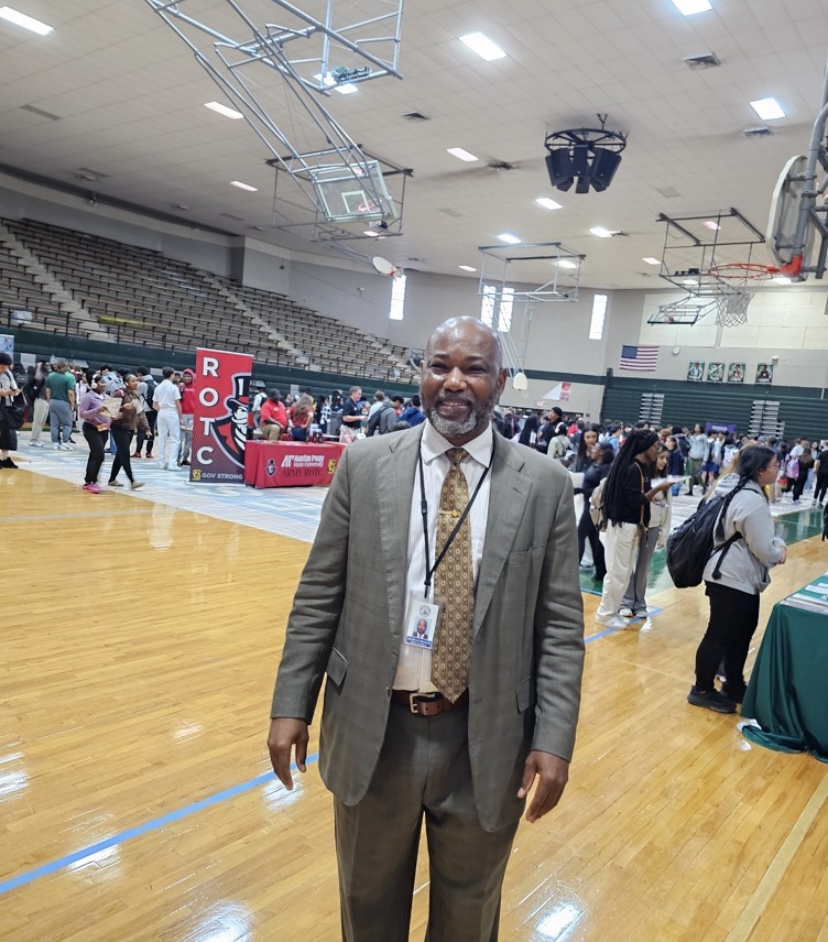




The auditorium lights illuminate the wooden stage as orchestra students move to their sections. The students get seated, adjusting their papers with their stand partners. Before them is a crowd of people who came to hear music and support their peers or family members. But in the middle of it all, with his back to the crowd, is the conductor. For White Station High School’s (WSHS) orchestra, this director is Andrew Palmer.
Palmer was born in Virgina, where he grew up surrounded by music. His mother was an avid pianist, so he learned the instrument at a young age. Piano and bass, which he learned through school, therefore became Palmer’s passion very early on.
“There was music in the house [when I was growing up],” Palmer said. “My mom was a pianist, so that was that. [I also did] church choir. Elementary school stuff. [I] started piano lessons in the third grade … and then fifth grade strings were offered at my elementary school … so I tried fifth grade strings and started playing the bass there, and I’ve played ever since.”
When Palmer graduated high school, he attended James Madison University in Virginia, where he met his wife. From there, he got a masters from the Peabody Institute in Baltimore. He finally made his way to Memphis in 1991 to get a Doctorate from the University of Memphis, which was then called Memphis State. Palmer chose the school because of the orchestral hub that Memphis had become, and for the assistantship to the doctorate he was offered. After graduating in 1995 with his Ph.D., he was offered a teaching position for Memphis City Schools, who needed a last minute replacement. Although it was his original plan to play for an adult orchestra full-time, he took the job.
“[My position is] a full-time job, but it really is a combination of a lot of different positions,” Palmer said. “All of the string teachers are full-time employees, but most of us have more than one school because to be specialists in our area, even [at a] school this size, we have two orchestra classes. We don’t have five or six. So in order to use our specialties the best, we travel from school [to school].”
This year, Palmer teaches at Grahamwood Elementary School, Riverwood Elementary School, White Station Elementary School, WSHS and some other schools working as a bass specialist. This means that throughout his day, Palmer is traveling to multiple schools. This comes with its drawbacks. For one, he does not have a set community of teachers that he interacts with every day. He also has to travel from place to place and oftentimes does not get notified about various school functions or alternative schedules, creating situations where sometimes he misses a class. On the other hand, he gets out of the classroom more, and teaches a larger variety of grades, and sometimes gets to see his students grow up with music in the same way he did. He can teach a child when they are in elementary, middle and high school if their schedules align.
“When I have a fifth grade beginner that then plays all the way through and graduates from here, or any high school, especially if it’s [at White Station] — that is satisfying,” Palmer said. “And that makes it really hard to say, ‘Okay, well, when do I stop?’ Because there’s another fifth grader that I would like to teach all the way through. At some point, yes, retirement happens. But when you’ve got that fifth grade kid that you can show how to put a bow on a string, horsehair on a metal string on a wooden box, and it goes scratch and squeak, and then they’re playing sonatas and concertos in high school, maybe going on to college, [how can you decide when to quit?]”
Having taught at multiple elementary schools during his career, Palmer has learned that it is quite different than teaching older grades. They can learn more content at a faster rate; however, they are limited to the basics.
“[When I first started teaching elementary students I thought Twinkle] Twinkle [was] just going to drive me crazy … And my mentor teacher told me it will take three to five years before you realize that what you’re doing at the beginning of the year will result at the end of the year in something that sounds like music,” Palmer said. “And it took a few years. I appreciated that advice … So at the elementary level, what I’ve learned over the years is that they can learn something [new every time] I see them.”
On the other hand, high school and middle school students often have to take things slower, having already learned the basics and are now focused on more technical and challenging musical elements. The shift from beginners to Palmer’s more advanced older students is notable, and it is necessary to adapt his teaching for older students.
“Once you get into middle and high school, the progress is you hit walls and then it levels off,” Palmer said. “In high school, they don’t learn [as rapidly because] the ladder of progress is pretty steep for elementary, and for high school it’s more gradual.”
Palmer teaches two classes at WSHS, intermediate and advanced orchestra. Intermediate orchestra is a lower-commitment class that anyone can sign up for, while advanced orchestra requires the students to audition for their spots and attend various events. These include school events like open houses. Nonetheless, Palmer urges his students to practice and enjoys being able to play a wide variety of music with them.
“In a society where everything is automatic, like, you know, open the box, play the video game, and if I can’t figure it out, oh well, [music is different because it takes] time to develop,” Palmer said. “I appreciate that the kids, when they put the time in [they improve, but also] they realize sometimes you don’t get better. There are plateaus … and then all of a sudden there’s a breakthrough and you figure out something, do something better than you have before.”
Palmer has found great importance in music; and so can his students. Music can provide a community for students who might not have met otherwise, across grade levels and other social groups. Music also activates multiple parts of the brain, which can improve cognitive functions such as attention, multitasking and even memory. Music helps with self expression as well, giving Palmer’s students a creative outlet in their lives.
“[Music] does satisfy your soul,” Palmer said. “You know, we’re not just creating people to think, we’re creating people to express, to appreciate, to enjoy what there is … So there is something about the whole person and not just the math facts, the science facts, those sort of things. In music, there’s never only one right answer. Four plus two equals six, period, right? But in music, you can make that four last a little longer. You can make the two go a little higher. You can express that in so many ways.”