




















25 years after the release of his based-on-true-events, directorial magnum opus, “Almost Famous,” filmmaker and writer Cameron Crowe serves an inside scoop on the period of his life that served as inspiration for the critically acclaimed film.
Crowe sets the scene by reminiscing on his upbringing in the deserts of America, sharing charming anecdotes about his eccentric, self-prescribed psychic, school teacher mother who had a fiery hatred for rock and roll. Being a woman with strong roots in education, the raucous, irresponsible and intrinsically provocative nature of the music scene speaking most clearly to the youth at the time struck dissonant chords with her staunch beliefs in discipline and self-improvement. Rock and roll was banned in the household, and it was the end of the world for Crowe and especially his sister, Cindy, a devout rock lover.
Along with wistful memories that can be looked back on with a smile: Crowe’s father staying up on New Year’s Eve to record an Eagles concert for his son, a mother and son escapade to an enthusiastic Elvis concert, or a second adventure to an Eric Clapton concert, after which Alice Crowe finally begins to respect her children’s beloved tunes saying, “I understand your music. It’s better than ours,” pensive family drama is also exhumed. The drama typically centers around Crowe’s sisters, Cindy, the cool, free spirit who feels restricted by her mother’s iron fist, and Cathy, the docile eldest sister, who is othered by the society around her and ostracized by her peers, causing her to spend time housed in mental institutes.
The former, in an effort to greater the distance between her and her home, pursued a career as a flight attendant, and the latter, just after being released from the mental hospital, was found unresponsive in her bed after suffering an overdose. She was only 19. Both sisters had an immeasurable effect on Crowe’s love of music, with Cindy being the vinyl smuggler, stashing the works of artists such as Janis Joplin, The Doors, and The Byrds, and Cathy as the hopeless romantic, swooning over the songs of the Beach Boys and the Tremeloes.
Crowe shares a story where Cathy attempts to aid in Crowe’s wooing by helping him pick out a record to deliver to a girl he likes. The two settled on a record featuring the Tremeloes song, “Silence Is Golden,” but to their misfortune, Crowe’s object of affection is already in the hands of another. She accepts the gift, telling her boyfriend, “[Cameron] gave us a record. Wasn’t that nice of him?”
The beginning of Crowe’s rock journalism journey starts with a messy mini-mansion housing the team behind the local, free publication, the Door. While there with Cindy, who was there looking for a job, Crowe disobeys his sister’s advice of, “Try not to talk too much,” and requests to write a review of the new James Taylor album. To his avail, his wish is granted, and he begins writing for the paper.
In a scene that parallels one from “Almost Famous,” a young Crowe approaches the backstage door for an interview with the band Wild Turkey. He presses down on the buzzer to the right of the door, only to be met with Scotty the security guard.
“You’re not on the list. Go to the top of the ramp with the other girls.”
After a few more failed attempts, Crowe retires to the top of the ramp, defeated. But suddenly, his luck turns around as Larry Vallon, the show promoter, spots him and leads him inside. There, he’s given the opportunity to interview not only Wild Turkey, but also Yes and Black Sabbath.
With a bag full of cassettes and confidence, Crowe decides to send his work to his idol, Lester Bangs, a contributor to the Door, and an editor at the rock magazine, Creem, requesting an assignment. A week later he receives a letter back from Creem with the name “Bangs” scrawled in the upper right corner, which read:
“Your writing is damn good. Why don’t you give us a thousand words on Humble Pie?”

Crowe was triumphant. It was like seeing his name in lights, but instead it was his name printed in the magazine he read habitually at the bus stop. He was still writing with the “Door,” and had an interview with the Eagles where they encouraged him to “lead with your optimism.” He was starting to find his footing, but this was still just the beginning.
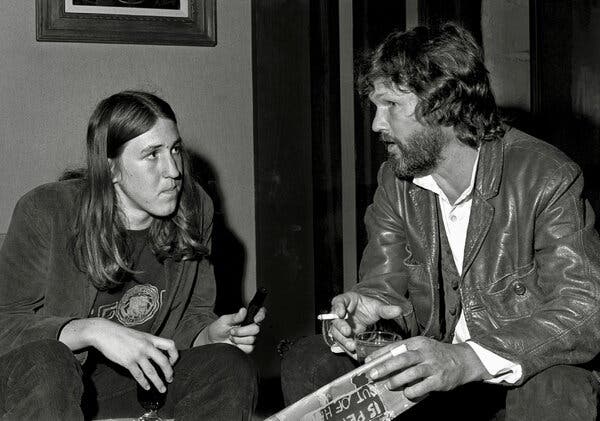
It was 1972. Kris Kristofferson was in town, and Crowe was set for an interview. It went fantastic, Kristofferson planted seeds for the young journalist’s future career in film, expressing the sheer emotional array one can capture in a movie. But most important for Cameron Crowe in that moment, an inebriated Kristofferson let it slip that Bob Dylan had recorded an entire album. No one in the press knew this. It was a triple-decker scoop drizzled in chocolate sauce, and it was just given to a 15-year-old freelance writer who had, up until recently, only been writing for his local paper.
After a phone call with Judith Sims, an editor at Rolling Stone, Crowe is set to write a blurb for the magazine. He was assigned to go to Los Angeles to conduct more interviews with Kristofferson, who had left his information with Crowe. His mother disapproved at first. She wanted her son to pursue a career in law, but she was ultimately convinced. Crowe was LA bound.
Crowe finished his blurb, but this wasn’t the end of his work with Rolling Stone, for he would end up writing articles about The Allman Brothers, Led Zeppelin, David Bowie, and Joni Mitchell, all during a time where artists were distrustful of the press. He charmed the artists with his authenticity, by being his “uncool” self. They were coaxed out of their mile-high walls of defense, and opened up to the starry-eyed teenager chasing his dreams.
Years passed of Crowe contributing articles, and he eventually began to burn out. He decided since he had a more-than-minimal high school experience from constantly touring and graduating three years early, that he would attend high school undercover and write about students from their perspective. His collection of findings became the book, “Fast Times at Ridgemont High.”
The book soon became the cult classic film of the same name, which Crowe screenwrote due to his inexperience in directing. This inexperience wouldn’t last long.
Crowe recounts a story with Tom Petty where, after conducting some on-camera interviews for the documentary, “Tom Petty: Heartbreakers Beach Party,” the rockstar encourages Crowe to pick up the camera. From the moment he pressed the record button, he was hooked. It was a full circle moment, going back to his interview with Kristofferson in his adolescence, and ending with Tom Petty.
“Congratulations,” Petty said. “You’re a director.”
Crowe would go on to direct the movie “Almost Famous,” which nearly 20 years later, turned into “Almost Famous: The Musical.” He had pivoted into the realm of film and then once again into the realm of theater with his story about finding your tribe and staying true to yourself.
Alice Crowe had been a confidant for many in her lifetime, and now, her son was expressing all his doubts and worries about his new musical project to her. She had a collection of comforting aphorisms, which Crowe sprinkles throughout his memoir. As much as the book is about his career, it’s also a love letter to family.
Crowe starts and ends the book with his loved ones, which become as fleshed out and brought to life as the rockstars they share space on the pages with. He recounts his sisters’ love of music and how his parent’s initial disapproval of his career slowly dissipates when they see the strides their son is making and how his creativity had flourished and was being celebrated.
The book itself is a celebration of authenticity. Crowe’s rich and optimistic writing urges you to find your niche and pursue it because eventually you’ll find the people who’ll appreciate it. Even if you’re “uncool,” there’s always a place for you to feel loved and accepted.