














From helping people without health insurance to launching a free international newspaper to drafting a bill on teacher wages, Pragna Rajashekar’s (12) advocacy has taken her throughout the Memphis community and beyond.
During her freshman and sophomore years, one of Rajashekar’s family members was hospitalized for an extended period. Because she was too young to go into their hospital room at the time, she sat in the emergency waiting room. There, Rajashekar saw many people struggling not only with the stress of having a loved one in the hospital but also the burden of not having insurance.
“You see … people struggling to pay for their loved one’s treatments, and people just crying because they don’t know what’s going to happen in the next 24 hours,” Rajashekar said. “It kind of opened my eyes to the … [financial] disparities that people have, especially in the health care sector. A lot of people can’t pay their medical bills, and it’s something that we as a community should help them [with].”
Teaming up with Dalena Ngo (12), Rajashekar founded the organization Caring Hands to address this problem. They collect donations to provide basic necessities and financial support to Memphians in various hospitals who may be struggling to pay for treatment.
“We just donated hundreds of dollars … to the VA [Veterans Affairs] hospital,” Rajashekar said. “Right now we’re working on doing a clothes drive. So we just give [people in hospitals] financial resources and anything that they might need. And we usually pick one hospital per year, and our focus [this year] has been mainly the VA hospital.”
Recently, Caring Hands has expanded to include an education branch with a free international newspaper. Rajashekar is specifically responsible for coordinating the publication, which receives contributions from people around the world and covers current issues from an objective stance.
“We basically talk about politics, business, finance, health — anything that you need to know to survive in our society,” Rajashekar said. “If I didn’t know what’s going on in society, and I didn’t have the resources to go buy New York Times or Washington Post, I [could] just use [this newspaper], where we research from those big articles, we add our own insights from various articles … and then we allow people to read it … My goal is to reach as [many] people as possible.”
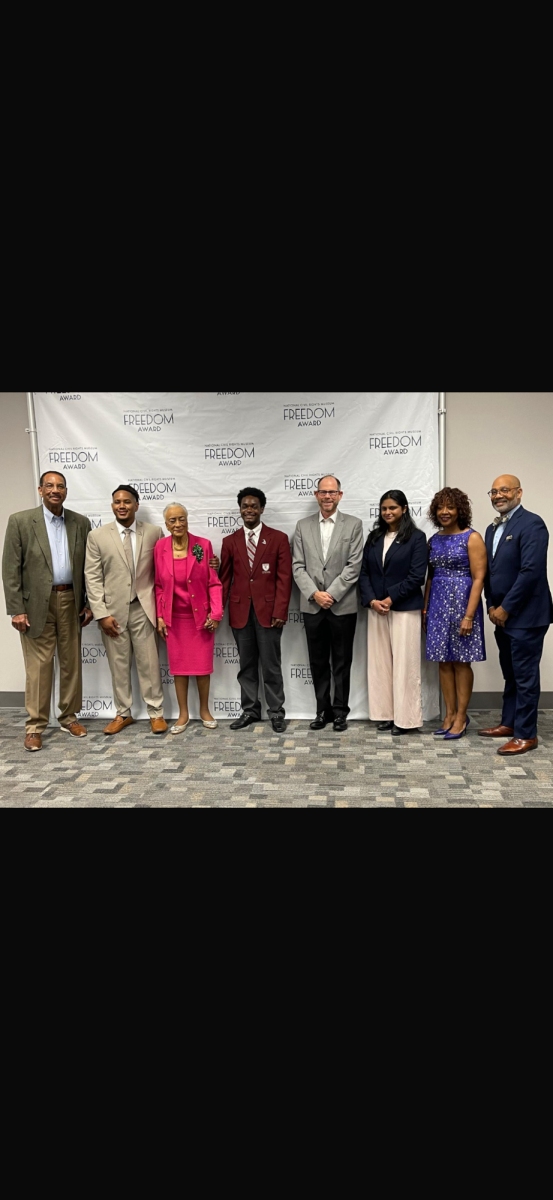
Rajashekar received the 2025 Martin Luther King (MLK) Keeper of the Dream award for her work with Caring Hands. Awarded annually by the National Civil Rights Museum, the award recognizes Memphis youth in 6th-12th grade who demonstrate dedication to promoting justice and equal rights in their communities. As a result, Rajashekar was also able to meet the 2025 Freedom Award winners, who are recognized by the National Civil Rights Museum for their commitment to justice on a global stage.
“One example would be Mark Suzman, who’s the Gates Foundation CEO,” Rajashekar said. “So I was allowed to meet with him, and … we were basically talking about the things we’ve done in our community, and getting recognized by Mark Suzman was incredible … I saw that Bill Gates reposted something about Mark Suzman winning that award.”
Rajashekar has not stopped expanding the scope of her advocacy; working with city councilwoman Yolanda Cooper Sutton, she is drafting a bill for the Shelby County government proposing increased wages for teachers. According to the Commercial Appeal over 300, or roughly 5%, of Memphis Shelby County Schools’ teaching positions were open at the start of the 2025-26 school year. Rajashekar hopes that higher salaries will incentivize teachers to stay in Memphis, improving the quality of education.
“If we give more incentives for teachers to stay, they won’t leave and go to Dallas, where they know the pay is better, or Atlanta,” Rajashekar said. “Then we can increase the amount of knowledge that … youngsters have in Memphis.”
Rajashekar’s experience at White Station High School has also expanded her views of society and inspired her fight against injustice. Classes like Advanced Placement (AP) English Language and Composition, taught by Lauren Larson, and AP English Literature and Composition, taught by Alison Hollis, have broadened her horizons through reading.
“Ms. Larson, she … expanded my political views,” Rajashekar said. “She made us read a lot of articles that made me think more about our society, and [with] Mrs. Hollis … right now, we’re reading a lot [of] feminist literature … It’s eye-opening to see that many different aspects of society, and it really … expands your mindset on what’s going on around us.”
These classes have also increased Rajashekar’s value of dialogue across the political spectrum and understanding different points of view. Through her work, she was able to speak to Marsha Blackburn, one of Tennessee’s senators, about a new bill that Blackburn drafted.
“I actually had the opportunity to speak with Marsha Blackburn … about gun violence, and we do have different viewpoints on what we would do [about] gun violence,” Rajashekar said. “I was like, ‘Why would she do that [to address gun violence]?’ … But hearing why she made a bill that she did … why her viewpoint is what it is, it really opened my eyes.”
Although Rajashekar has had the opportunity to perform work with lawmakers and grow her organization, she reminds students that positive change at any scale matters. Rajashekar also emphasized that a supportive community can help create real change, and advocacy can be much less intimidating when working in a group.
“Because when people think of Memphis or talk about Memphis, usually they talk about it in a negative light, and … they don’t really do anything to uplift Memphis,” Rajashekar said. “But if you see a problem and you know you can make a solution for it, I would say work towards making that solution, [whether] you think it’s small or big … It’s going to be hard to do it alone. So if you find a community … you can really make a difference. And the more differences you make, [the] more people will join in with you.”