





















You are on a roll doing a research assignment and the next website on Google seems really useful. You click on it, it loads and all that appears on your screen is a giant iboss logo and the words “Page Blocked: Access to the requested site has been restricted due to its contents.”
This situation is almost a daily experience for students who use school-issued devices for their work. A whole range of website categories, from Google products to political news to image searches, is blocked for a variety of reasons including possible distractions, viruses and inappropriate content. However, some of these websites offer potential learning along with their potential harms. It takes a careful balance to decide the net value a website offers, and when this balance is not maintained, lesson quantity and quality can suffer.
“Every day, there are resources and sites and links, videos even, and worksheets, practice exercises, online practice portals that I could give my students that I can’t because … all foreign domains are blocked on Memphis Shelby County Schools Wi-Fi,” Dylan Lira said. “That means, as a Japanese teacher, if there’s a resource hosted on a Japanese website [or] a Japanese domain, I can’t give that to my students because it’s blocked on the school Wi-Fi.”
These restrictions have been exacerbated by recent events. Personal devices are not affected by website blocks, so formerly they were an alternative. But the most common type of personal device, a phone, was banned for classroom use around three months ago.
“In the past, I could say, ‘Oh, that’s fine, pull the article up on your phone, or pull up the practice exercise on your phone,’ but [not] with the ban on the phones in the classroom,” Lira said.
Several students have access to personal laptops and thus the whole internet. So, some teachers, not wanting to go without superior learning resources like Google or foreign language keyboards, assign lessons that require access to blocked sites. Those who have their own devices can work on the classwork in class, while other students are expected not only to find an alternative way but to also find another time to do it.
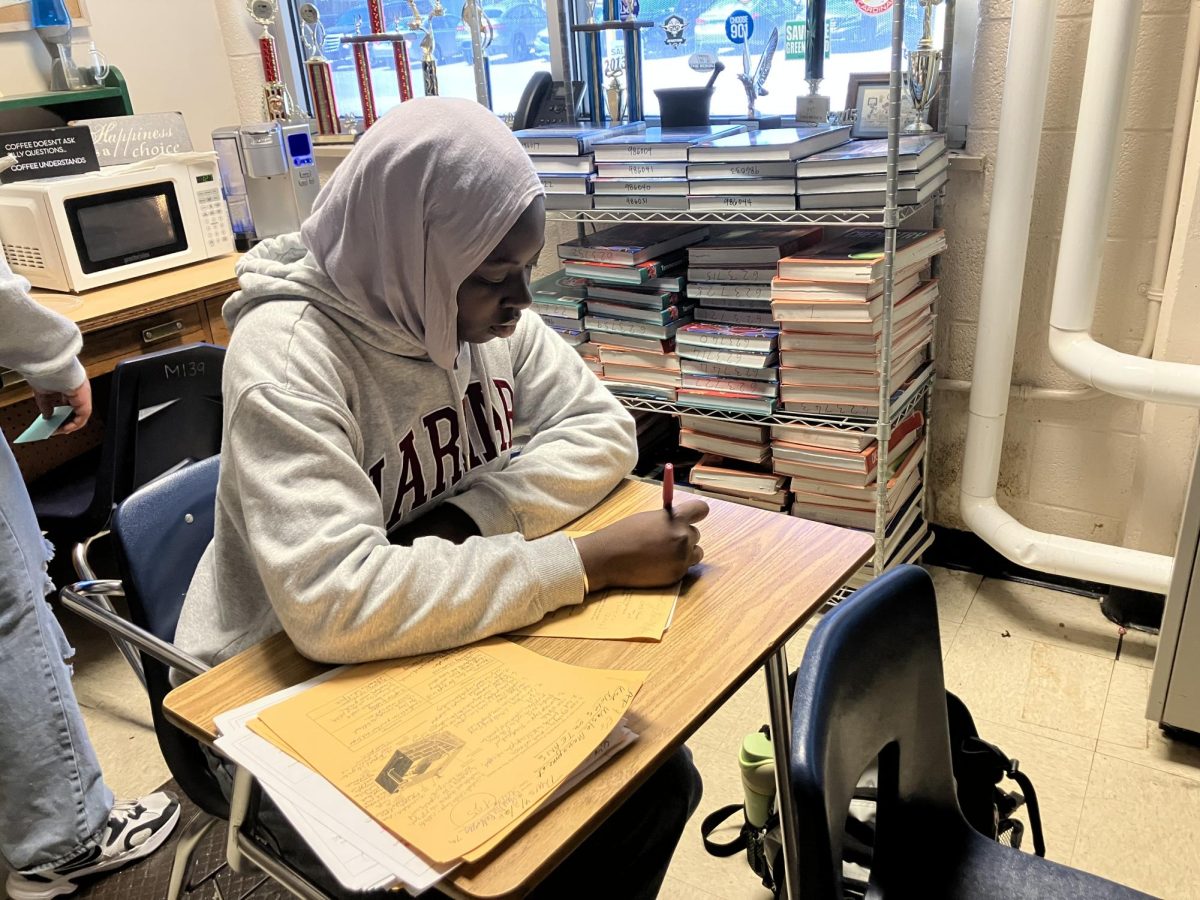
“I have to go home and go on my home computer and do it, which I could have did it at school, so it becomes homework and more work for me to do,” Marquez Vanhooks (11) said.
Turning classwork into homework has significant side effects. For one thing, being at home usually means being alone, so teachers cannot provide feedback and students cannot collaborate. Some students with after-school commitments or jobs rely on being able to complete work in class, as they have no ability to do it at home. Even for students who can do it, homework digs into their free time, and some may turn to alternative methods to preserve their breaks.
“Blocks on school devices make me tempted to use ChatGPT,” Kailyn Card (12) said. “They make me tempted to not do the assignments. Yes, they make me want to use my phone and other resources that I can use, because I hate doing work at home.”
Despite the difficulties that blocks cause, the situation is complicated. Some blocks are not chosen by the district but by the federal government, which requires certain restrictions in order to provide grants under the Children’s Internet Protection Act. For those chosen by the district, the size of Memphis Shelby County Schools (MSCS) means that individual attention is often difficult to offer.
“Every time I would put in a complaint … it’s never been respected enough or had enough attention to it because there’s so much other stuff, but the fact that it’s multiple students who still go through this, just like me, and it hasn’t been brought up to attention is still a problem,” Vanhooks said.
Despite having over 200 schools, 100,000 students and 6,000 teachers, the MSCS district has no standardized system to streamline requests for exceptions to its blanket block policies.
“A lot of how IT works in the school system trickles,” Lira said. “And even as a teacher, if I wanted to get something approved on the school Wi-Fi or on the devices, the amount of steps that I have to take is so long-winded and inefficient.”
Technology and its restrictions are sometimes hard to adapt to, but for many students, teachers and administrators, the change seems necessary to live in a changing world.
“I think we need to use more technology in the classroom overall,” Lira said. “I think that yes, it’s true that technology can cause problems, and yes, it’s true that teenagers will be teenagers and allow themselves to be distracted or tempted by off-task usage of technology, but the pros outweigh the cons tenfold, and the businesses, groups, learning environments that efficiently use technology are unmatched.”